Who this is for
This work belongs to the start of a stay. A tenant has arrived with a TV still in its box. An owner has collected the keys in one of the newer towers and the windows are bare. An agent wants both done before a handover. Mont Kiara is nearly all high-rise, but the first question is the same in a house or an office: what is the wall. The second, what the building allows, applies wherever there is a management.
First, what is the wall
Mont Kiara's towers were built over three decades, from Mont Kiara Pines and Palma in 1993 and 1994 to 10 Mont Kiara, 11 Mont Kiara and Verve Suites in the 2010s. One unit can have three kinds of wall, and the age of the tower does not tell you which is which. Knocking, a detector and one small test hole do.
| Wall | How it shows itself | Fixing | What it carries |
|---|---|---|---|
| Concrete | Solid when knocked, slow to drill | Wall plugs and screws, or sleeve anchors for heavy loads | Any bracket, long shelves, heavy mirrors |
| Brick under plaster | Solid when knocked. Plaster first, then brick. | Plugs and screws long enough to seat in the brick | TV brackets, curtain rods, shelves |
| Lightweight partition | Hollow when knocked | Screws into the frame, a backing board across the frame, or hollow-wall anchors | Light items on anchors. A TV only through the frame or backing. |
| Tiled wall | A glazed face over one of the above | A tile bit at slow speed, then the fixing for the wall behind | Bathroom accessories and mirrors |
Houses follow the same table with a different mix. Older ones are mostly brick under cement plaster, which grips a plug well. An extension or a renovated room may be lightweight block or a board partition, so one house can have a kitchen wall that takes any bracket and a bedroom wall that takes none. Knock on each wall before you plan.
The 300 mm rule
The strata by-laws do not allow drilling, hacking or screws within 300 mm of concealed pipes and conduits. The contractor is to use a detector and check the as-built plans kept at the management office.
This bites on TV walls. Concealed conduits usually run straight up or down from a switch or socket, and the wall you want the screen on is usually the one with the sockets and the aerial point. A wall that backs onto a bathroom may carry pipes. So the detector goes over the area first and decides where the fixings can go. Sometimes the answer is a different wall or a floor stand. A house on an open street is outside those by-laws, but its walls hide pipes and conduits all the same, and the detector is used in the same way.
TV brackets: what you decide
- The TV's size, weight and VESA pattern: the spacing in millimetres of the four mounting holes on the back. The bracket has to match all three.
- Fixed, tilting or full-motion. An arm that swings out pulls harder on its fixings, which matters most on a partition.
- Height. Tape the outline on the wall and sit on the sofa before you confirm.
- Where the plug, the aerial point and any set-top box will sit.
Curtain tracks: ceiling or wall
Many condo living rooms have a balcony door or tall window with little or no wall above the frame, so the track goes on the ceiling. What matters is what the screws bite into. A plaster ceiling carries little weight, so a track for heavy blackout curtains needs fixings that reach the concrete slab or a solid backing above the board.
Where there is a clear band of wall above the window, a rod or track on wall brackets is the other choice. A sheer and a blackout together need a double track. Nothing is fixed into the window frame.
How the visit goes
Mark
Positions are taped on the wall or ceiling and agreed with you.
Scan
The detector goes over each mark. One too close to a pipe or conduit is moved before the first hole.
Drill and fix
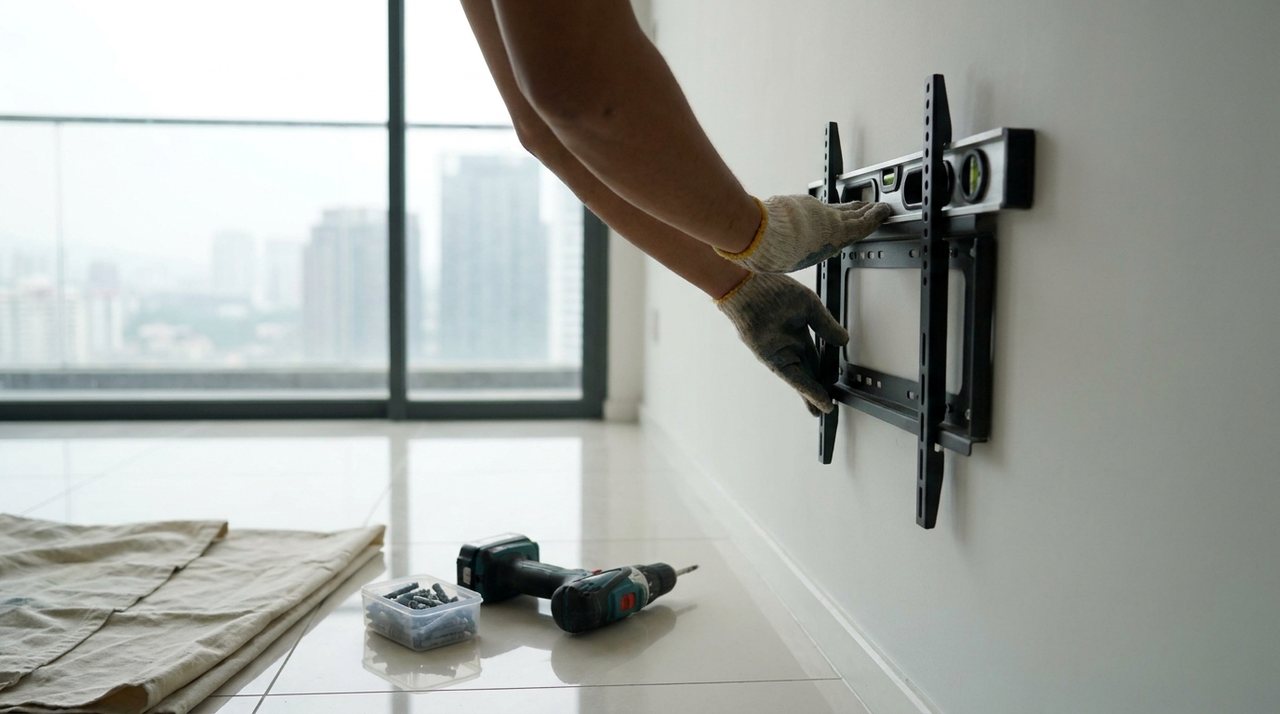
Dust is caught at the bit. The bracket or track goes up, is checked with a spirit level and pulled by hand before it takes any load.
Hang and tidy
The screen is hung and connected, and the floor is vacuumed.
What can stop the job or change it
The detector finds a pipe or conduit where the fixing must go. The wall is a partition with no frame behind the spot. The surface is a stone or glass panel that may crack under a drill. Or, in a strata building, the management office treats the work as renovation: the by-laws ask for the management's written approval before renovation works and allow it to ask for a deposit, and whether a few holes for a bracket count is the management's decision. Many management offices also keep drilling to set hours on working days. Ask yours before the day.
What moves the cost
The number of items, the wall type and the anchors or backing it needs, the size of the screen, the length of each track, and how the cables are dressed. If you are fitting out an empty unit, add downlights and light fittings or a ceiling fan to the same list. Holes left by an old bracket go on the small repairs list. Whiteboards, notice boards and meeting-room screens are on the offices and shops page.
Questions about brackets, tracks and cables
Can a TV be mounted on a partition wall?
Often, but never on the board alone. A partition is board on a frame with a hollow gap behind. The bracket is screwed into the frame, or onto a backing board that spans it, so the weight goes into the structure. Hollow-wall anchors alone suit light things such as pictures.
Are curtain tracks fixed to the ceiling or to the wall in a condo?
Usually to the ceiling. Tall windows and balcony doors leave little wall above the frame, and a ceiling track lets the curtain hang the full height. The fixings must reach concrete or a solid backing, not plasterboard alone. Where there is clear wall above the window, wall brackets are an option.
Can the TV cables be hidden so nothing hangs below the screen?
There are two ways. One is a slim trunking on the surface, painted the wall colour. The other is a channel cut into the wall or a socket added behind the screen. Cutting is hacking, so ask the management for written approval first. A new socket is wiring work, which is regulated in Malaysia: ask who will do it and what registration they hold. A new point is identified before any quote.