
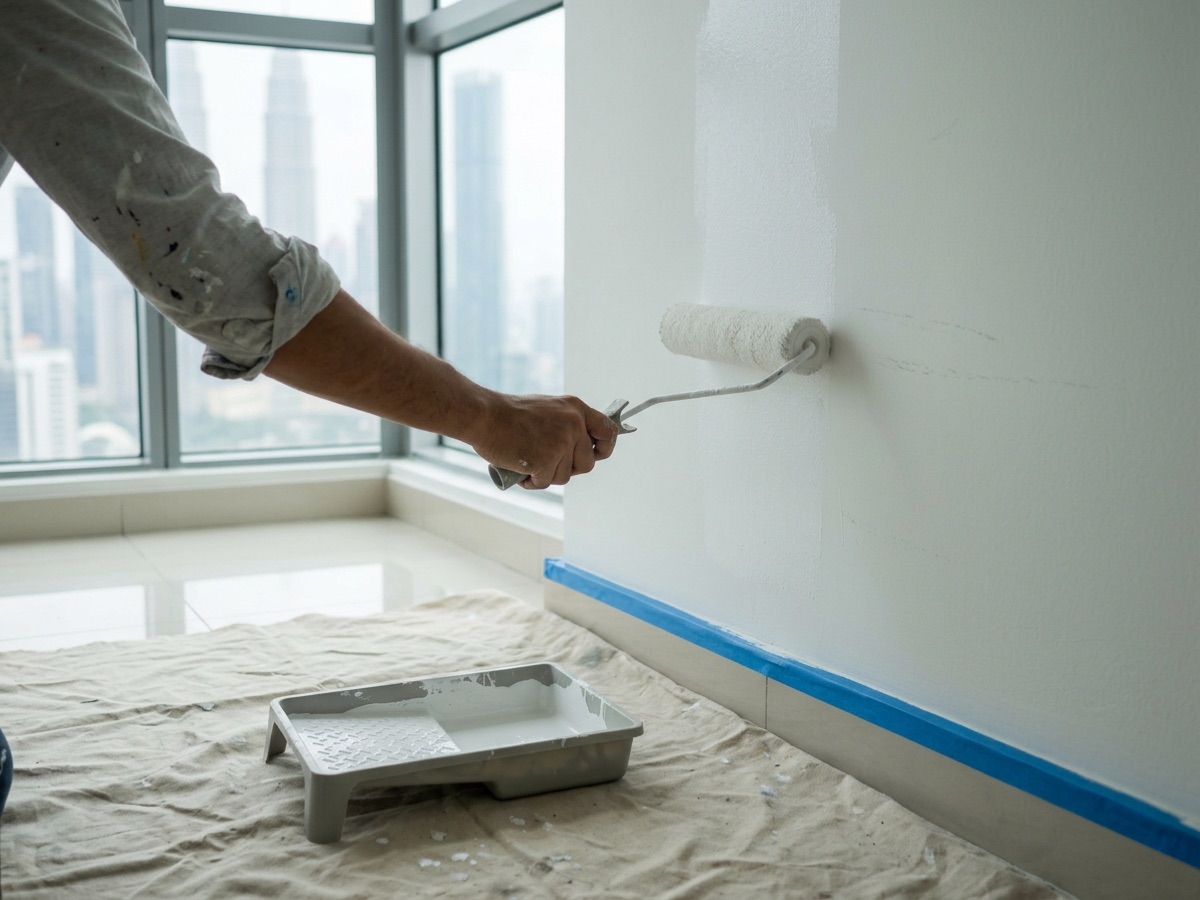
What a tenancy leaves on the walls
Walls keep a record of whoever lived there. Picture hooks leave nail holes. A TV bracket leaves four large ones. A sofa rubs a grey line along the living room, and one bedroom was painted blue in the first year. When the unit changes hands, someone has to deal with it: the tenant before moving out, the landlord before the next viewing, or the agent in between.
Painting and touch-up here means small work. Holes are filled, marks are touched up, and one wall or one room is repainted. The question is the same in a 1990s block such as Mont Kiara Pines, a 2010s tower such as Residensi 22, a terrace house or a shop unit: touch up, or repaint the wall?
Who decides what has to be made good
Your tenancy agreement does. It usually sets out what state the unit is to be returned in, and whether holes and marks are yours to put right. This page gives no view on what counts as fair wear. If the agreement leaves you unsure, ask the landlord or agent before you pay for paint. An office or shop going back to its landlord is in the same position, and that list is on the offices and shops page.
Why new paint shows on an old wall
Paint changes after it goes on. It fades in daylight and dulls with age, so new paint of the same colour can still look different beside it. Sheen is the second problem. A brushed patch reflects light differently to a rolled wall, and the difference is plainest when daylight falls along the wall.
A close match needs the original paint: the maker, the colour name or code, and the finish. Landlords sometimes keep the tin or a note of the code, so ask. Without it, the dependable way to hide a repair is to repaint the whole wall from corner to corner. A corner hides a small difference in shade. The middle of a wall does not.
| Touch-up | Whole wall | Whole room | |
|---|---|---|---|
| Suits | A few filled holes or marks, with the original paint to hand | Many holes on one wall, a large repair, or no record of the paint | A coloured room going back to white, or marks on every wall |
| Where it can show | At each patch, in side light | At the corners, faintly | Not on the walls, as a rule |
| What to send | Close-ups, the paint maker and code | A photo of the whole wall | A photo of each wall and the rough room size |
| Ceiling | Left alone | Left alone | Say if you want it included |
Holes, cracks and what goes under the paint
Nail holes, screw holes and hairline cracks are filled, left to harden, sanded flush and spot-primed. The primer matters. Bare filler soaks up paint, and without primer the repair shows through as a dull patch.
A crack that keeps opening again after it has been filled is worth reporting to your landlord or management office. Paint will not hold it shut.
A coloured wall going back to white
A strong colour does not vanish under one coat of white. It takes an undercoat or extra coats before the old colour stops showing through, and how many depends on the colour and the paint. That is why a feature wall is quoted as a whole wall and never as a touch-up.
Stains and mould
A water stain is the mark of a leak. It is painted only after the leak has been cured and the wall has dried. It is then sealed with a stain-blocking primer, or it comes back through the new paint. If the stain sits under another unit's bathroom, the plumbing page covers how a leak between floors is reported.
Mould is washed off and treated before any paint goes on. Where the damp continues, paint does not solve it.
How the room is protected
Floors and furniture are covered. Edges are masked: skirting, switch plates, door frames, window frames. The usual wall paint indoors is a water-based emulsion. Drying between coats depends on the product and the weather, so a room may be out of use while the coats go on.
What is not taken on
- The outside of a building. In a tower the outside wall is usually the management's to maintain. The outside walls of a house are not painted either.
- Repainting a whole home as a project. One room at a time is the scale here.
- Texture and special-effect finishes. Plain painted walls only.
- Waterproofing. Paint is not a cure for water coming through a wall or slab.
How the job runs
Photograph each wall
One photo of the whole wall and a close-up of each mark. Add the paint details if you have them.
Touch-up or repaint
The reply sorts the walls into those that can be touched up and those better repainted. The quote comes with it.
Clear it where needed
If there is a management office, ask what it wants from contractors. The day is then fixed, Monday to Saturday, 9 am to 6 pm.
Fill, prime, paint
Filling and sanding first, primer on repairs and stains, then the coats.
What moves the cost
The number of holes and marks. Whether the original paint is known. How many walls or rooms are repainted, and their size. A strong colour to cover. Stains or mould to treat. A quote follows the photos.
Paint comes last on a handover list, after the small repairs are done and the brackets are down. If a wardrobe has to come apart first, see furniture assembly.
Questions about painting and touch-up
Can the existing wall colour be matched from a photo?
Not reliably. A phone camera shifts colour, and so does the screen it is viewed on. A match needs the paint itself: the maker, the colour name or code and the finish, read off the tin or taken from the landlord's records. If nobody has them, the wall is repainted from corner to corner in a white or colour you choose, so any difference falls at a corner.
I only have a few nail holes. Is that worth a visit?
Yes. A few holes is enough to ask about. Expect one caution: on an older wall, filled holes can show as fresh spots once painted, because the paint around them has aged. With the original paint the spots are usually acceptable. Without it, you may be advised to repaint that wall. Add any other small items in the unit to the same message.
Do I need to tell the management office about painting inside my unit?
Ask. Under the strata by-laws, renovation works need the management's written approval, and it is the management that decides whether repainting a room counts. Many offices also ask contractors to register at the guardhouse. Painting is quiet work, but the routine for contractors usually applies to it all the same. A short message to the office before the date is fixed avoids a wasted trip.