The list before handover
Mont Kiara has a large expatriate population, and a posting usually ends with a rented unit to hand back. The last weeks of a tenancy are when small faults get counted: by the tenant who wants a clean handover, by the landlord preparing the unit for the next occupier, and by the agent with a checklist. Sent together, they can usually share one visit.
In blocks from the 1990s and 2000s, such as Mont Kiara Pelangi, Bayu and Damai, door hardware and cabinet fittings may have been through many tenancies. In a tower from the 2010s the list tends to be shorter. Both are guesses from the buildings' age, so photograph what you have. A house or a small office collects the same list.
- A door bell that is dead or faint.
- Switch plates that are loose or cracked, and sockets that no longer grip a plug.
- Handles that droop, latches that do not catch.
- Cabinet doors that hang crooked.
- Black or peeling silicone around a basin or shower screen.
- Screw holes left by pictures and brackets, to fill and touch up.
Door bells
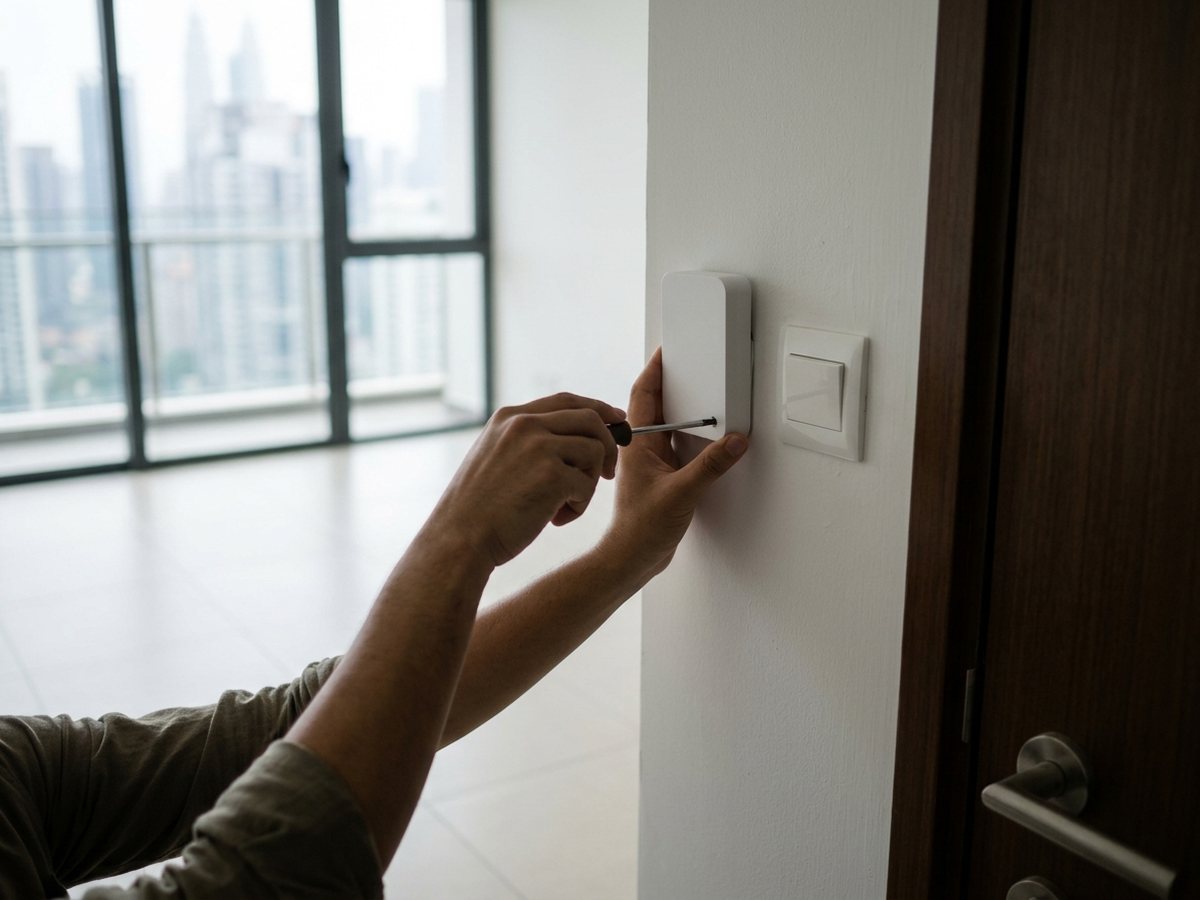
A door bell installation or repair starts with which kind you have.
| Wired bell | Wireless bell | |
|---|---|---|
| How the push reaches the chime | A cable inside the wall | A radio signal |
| Power | The unit's own wiring, in some sets through a small transformer | Batteries in the push. The chime runs on batteries or a socket. |
| Usual faults | A worn push, a failed chime, a loose or broken cable | Flat batteries, lost pairing, a weak signal through a heavy door |
| What a change involves | Work on wiring, which is regulated | Screws or an adhesive pad, no cable |
Ask the management office before a camera door bell or a new push is fixed on the corridor side of your door. Many buildings have a say on what faces the corridor.
At a house the push usually sits at the gate, out in the rain. It has to be a bell made for outdoor use, and with a wireless set the signal must carry from the gate to the chime indoors. Say how far the gate is from the front door.
Switch plates and sockets
A plate can be loose because its screws have backed out, or because the box in the wall has come adrift. A socket that feels warm or shows a brown mark should be left unused until it has been looked at. Everything behind the plate is wiring, and wiring work is regulated in Malaysia: Suruhanjaya Tenaga registers electrical contractors and competent persons. Ask who will do that part of your job and what registration they hold. A job that needs a new point, a new circuit or work at the distribution board is identified before any quote.
Handles, latches and locks
A lever that droops usually has a tired spring or a loose fixing. A latch that misses its plate often means the door has dropped on its hinges, and the cure is at the hinge or the strike plate. A replacement lockset has to suit the holes already in the door, so photograph them against a tape measure before you buy.
The main door of a high-rise unit is often a fire door, and many management offices want to be asked before it is drilled or its lock changed. If you are locked out, call a locksmith. That is not a job taken here. Sliding doors, window stays and door closers have a page of their own: door and window repairs.
Cabinet hinges
Kitchen and wardrobe doors usually hang on concealed hinges with adjusting screws, so a crooked door is often an adjustment. A door that has pulled its screws out of the board needs the holes repaired or a matching hinge. The cabinet under the sink suffers most, because a slow leak swells the board. Have the leaking trap or hose repaired first.
Silicone around basins and showers
Silicone goes black with mould and lets go at the edges. New silicone does not bond well to old, so the old bead is cut out, the joint cleaned and dried, and a new bead run. It has to cure before it gets wet, so plan to use the other bathroom meanwhile. Silicone seals a joint. It does not cure a leak through a floor, and no waterproofing is promised.
How a list is handled
Walk the unit with your phone
One photo per item, numbered to match your list or the agent's checklist.
Get the list sorted
You hear which items are adjustments, which need a part, and which belong elsewhere: a lock-out to a locksmith, a corridor fault to the management office.
One visit, by appointment
Where there is a management office or a guardhouse, the visit is planned around what it asks of contractors. Photos of each finished item go to a landlord or agent who cannot be there.
What moves the cost
The number of items, whether each is an adjustment or a replacement, whether a matching part can be found, and whether an item turns out to be wiring. A quote follows the photos. A handover list often runs on into TV mounting and curtain rails or downlight replacement. Put everything in one message, or use the contact page.
Questions about door bells, locks and silicone
I am a tenant. Do I need my landlord's approval before anything is mounted or replaced?
Your tenancy agreement answers that, so read it first. Many agreements ask for the landlord's consent before anything is drilled, fixed or changed. Separately, the strata by-laws bind tenants as well as owners, so the management's rules on works apply to you too. A written yes from the landlord or agent makes the handover easier.
Can work be done on a Sunday or in the evening?
No. Visits are booked Monday to Saturday, between 9 am and 6 pm. Many management offices also keep contractors' work, and drilling in particular, to set hours on working days, so check what yours allows. If you are at work during those hours, someone you name can open the door.
I searched for an electrician in Mont Kiara because a socket is loose. Is this the right page?
Start with a photo of the socket. Sockets and switches are wiring, and wiring is regulated work in Malaysia under Suruhanjaya Tenaga, which registers electrical contractors and competent persons. So ask anyone you book who will do that part and what registration they hold. If a new point, a new circuit or work at the distribution board is needed, you hear it before any quote.