Who this page is for
Astana and Aman belong to the 2000s layer of Mont Kiara condominiums. A tenant in a unit of that age, kept awake by a dripping tap, may be looking at a fitting that has been there since the block was new. Going by the date alone, a tap or hose never changed could be near the end of its life. That is a guess from the calendar, so the photo decides. Pantry and washroom taps in an office or shop are the same repairs; that list is on the offices and shops page.
This page is written for four readers: a tenant whose mixer drips all night, a landlord with an empty unit whose bathroom has started to smell, an agent who has found a damp cabinet under the kitchen sink, and a house owner whose garden tap will not shut.
What the photos need to show
Send these with the building, tower and floor, or the road for a house.
- The tap from the front and the side, handle included.
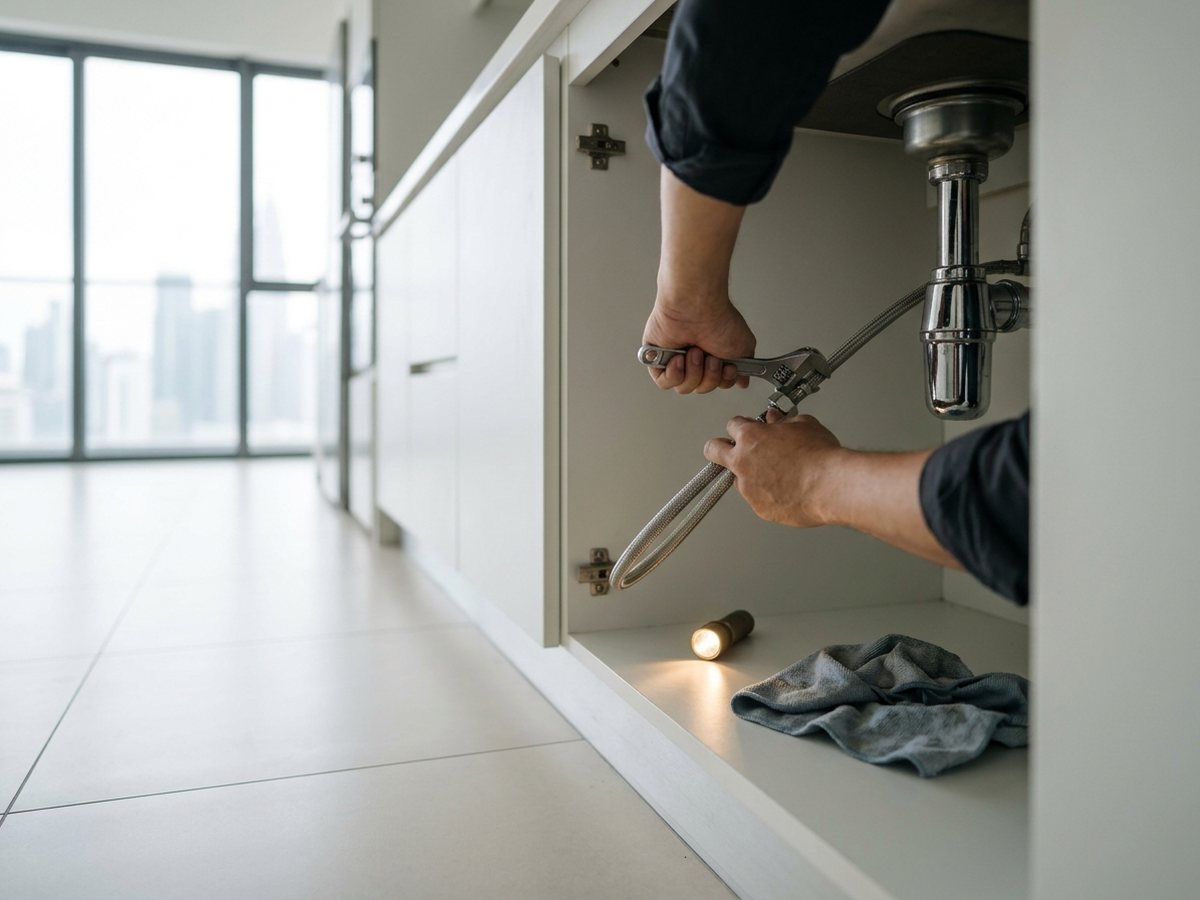
- Under the sink or basin: hoses, wall valves and trap.
- Inside the cistern with the lid off, or the flush plate if the cistern is behind the wall.
- Where the water shows up, on video if it only drips while something runs.
The four usual faults
A mixer that drips
A single-lever mixer meters water through a cartridge. When the spout drips with the lever shut, the cartridge is usually worn. If a matching one can be found, the tap stays and only the cartridge changes.
Flexible hoses
The braided hoses between the wall valve and a tap, a cistern or a bathroom water heater are wearing parts. Rust on the braid, a bulge or a damp end means the hose is replaced, never patched.
Traps
The trap under a basin holds a little water to keep drain smell out. A floor trap in a bathroom nobody has used for weeks can dry out and let the smell through, which is common in a unit waiting for its next tenant. Run water into it first.
A cistern that keeps running
Either water is slipping past the flush valve seal into the bowl, or the fill valve is not shutting off. Some newer units have the cistern concealed in the wall behind the flush plate, which makes the same repair more awkward.
At a house: the garden tap and the roof tank
A house adds two things a condo unit lacks. One is the tap outside, for the garden or the car porch. It lives in sun and rain, so it has to be a fitting made for outdoor use, and one that drips or will not shut is repaired or exchanged as the photo shows. The other is the tank in the roof space that feeds many houses by gravity. Pressure from it is often low upstairs, which matters when you choose a mixer or a shower set. Work on the tank itself is not taken on.
Repair or replace
| Fitting | Usually repaired when | Replaced when |
|---|---|---|
| Mixer tap | A matching cartridge or seal can be found | No part fits the model, or the body is corroded |
| Flexible hose | Never | The braid is rusty, the hose bulges or an end is damp |
| Basin or sink trap | A washer or nut is the cause, or it needs clearing | The body is cracked or corroded through |
| Cistern | The fill valve or flush seal is the cause and parts exist | Parts cannot be found, or the cistern is cracked |
Water-supply work is regulated
Work on the water supply is regulated in Malaysia, and SPAN issues plumbing permits. Ask who will do the plumbing on your job and what permit or registration they hold. If the photos show the job reaches the pipe in the wall or the unit's stop valve, you are told before any quote. So is a heater job that needs a new power point, a new circuit or work at the distribution board.
How the visit goes
Water off
The valve under the fitting is closed, or the unit's stop valve if that one will not seal.
Fitted and tested
The new part goes in. With the water back on, every joint that was touched is wiped dry and watched.
Left dry
The cabinet is wiped out. Old parts are photographed for a landlord who is not there.
When the water is not from your fittings
Water through a bathroom ceiling, or a damp wall with no tap near it, usually starts somewhere you cannot reach. In a house on its own title there is usually no management to notify, and the pipes on your side of the meter are usually yours. In a strata building it is less simple. As a general guide, pipes that serve only your unit are usually the owner's, while shared risers, the slab and the outside wall are the management's. The strata regulations set out a procedure for leaks between floors, and it starts with a notice to the management. So the first message goes to your management office.
Send us the photo as well: if the cause is a hose or trap inside your unit, it is quoted. Opening a wall or floor to reach a pipe is hacking. The by-laws ask for the management's written approval before renovation works, and the management decides what counts. Bathroom waterproofing is not a job taken here.
What moves the cost
The quote follows the photos and moves with the number of fittings, whether a matching part exists, how hard the fitting is to reach, and whether a valve or pipe has to be changed as well. A landlord clearing a unit can add fresh silicone and other small repairs to the same booking. To write instead, use the contact page.
Questions about taps, hoses and leaks
Water is dripping through my bathroom ceiling. Is that my unit's problem or the unit above?
It usually starts above you: a floor trap, a waste pipe or a shared pipe in the slab. Nobody can settle that from below. The strata regulations give a procedure for leaks between floors that begins with a notice to the management, so report it to your management office with photos. If it cannot be agreed, the Strata Management Tribunal is where it goes.
The valve under my basin is stuck. Where does the water for my unit shut off?
Each tap and cistern usually has a small valve on the wall beneath it. When that has seized, the whole unit is shut at its stop valve, which in many high-rise buildings sits by the water meter in a cupboard off the corridor. Ask your management office to show you yours and who holds the key. At a house it is usually beside the water meter, which often sits near the front gate or boundary.
My unit is in one of the older Mont Kiara blocks. Should every flexible hose be changed at once?
That is your decision. Hoses fitted at the same time age together. If one has rusted or bulged, photograph the others: under each basin, behind each cistern and at the water heaters. Changing the doubtful ones in a single visit means one booking with the building. A hose with a clean braid and dry ends can stay.