Who asks, and why the hole comes first
A tenant has one dead downlight in a row of six. A landlord is getting a unit ready between tenancies and wants every room lit in one colour. An agent has a carton of new fittings and keys to hand over. A house owner wants the porch light working again.
Take the agent's case in a 2000s condominium such as Banyan, with the handover date already fixed. Many units have plaster ceilings with recessed lights. In a block of that age the fittings have probably been changed at least once, so the holes in one ceiling are not always one size. That is why the first question is about the hole, not the light.
What the photos need to show
- The whole ceiling with the lights on, so the number of fittings and the dead ones are clear.
- A close view of one fitting with a tape measure held across its rim.
- The box label of anything already bought: cut-out diameter, wattage, colour temperature.
- The wall switch for those lights, and any dimmer.
Three things to settle before you buy
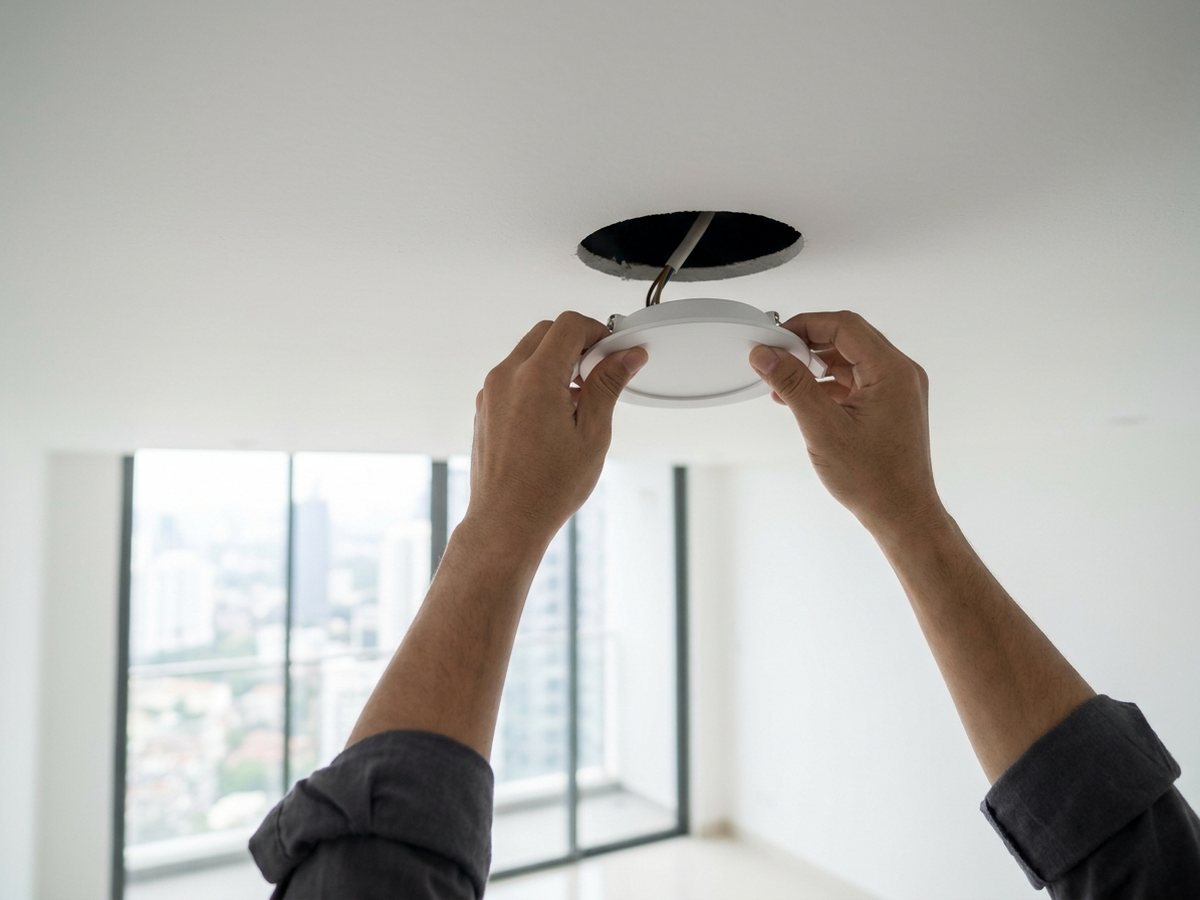
Cut-out size. A recessed downlight sits in a round hole in the plasterboard, usually held there by spring clips. The box states the cut-out diameter that fitting needs. Measure the hole, not the old light: the rim is always wider than the hole it covers.
Driver. Most LED downlights run from a driver, a small box that rests above the ceiling and feeds the lamp. When a downlight flickers or goes dark, the driver has often failed and the lamp has not. Some fittings let the driver be changed alone. Others are sealed.
Colour temperature. It is printed in kelvin. Around 3000K is usually sold as warm white, around 4000K as cool white, and 6000K or more as daylight. One odd lamp in a row shows at once, so match what is there or change the row.
When the new fitting does not match the hole
| New fitting against the old hole | What happens at the ceiling |
|---|---|
| Same cut-out | Old fitting out, new one in. No plaster work. |
| Slightly smaller, with a rim that still covers the hole | Often fits, provided the springs still grip the board. |
| Clearly smaller | The hole is closed down with a converter ring or a plaster patch. A patch needs paint. |
| Larger | The plasterboard is cut wider. The new rim hides the edge. |
How the visit goes
Circuit off
The lighting circuit is switched off and tested dead before any fitting is handled.
One fitting first
The first old downlight comes down so the hole, the cable and the space above the plaster can be seen. Anything that differs from the photos is said now.
Change and connect
Each new fitting is connected, its driver laid above the ceiling beside the hole, and its springs seated flat.
Test and clear up
Every light is run from its own switch, dimmer included, while you are in the room. Plaster dust is vacuumed and the old fittings are bagged.
What can stop the job or change it
- A shallow ceiling space. Some fittings are taller than the gap between the plaster and the slab. The depth is measured through the first hole.
- A dimmer. An LED fitting on an older dimmer may flicker or buzz. Either the fitting is a dimmable type that suits it, or the dimmer is changed.
- A heavier light. A pendant or chandelier with real weight is fixed to the concrete slab, not the plasterboard. The strata by-laws bar drilling within 300 mm of concealed pipes and conduits, so a detector goes over the slab first.
- The management. In a strata building the same by-laws call for written approval before renovation works, and it is for the management to say whether cutting a ceiling counts. Many offices also keep noisy work to set times. Check with yours.
Houses, porches and offices
Upstairs in a house, the ceiling is usually board under the roof and there is no slab above it. A heavy light there is fixed to the roof structure, and older boards are handled gently because they can be brittle. Lights out of doors, on a porch ceiling or a gate post, need fittings made for outdoor use, so check the box for that before you buy.
In an office or shop the lights are more often tubes and flat panels in a grid ceiling, exchanged like for like at the existing points. Those are on the offices and shops page.
The wiring side
Connecting a light fitting is wiring work, and wiring work is regulated in Malaysia. Suruhanjaya Tenaga registers electrical contractors and competent persons. Ask who will carry out the connection on your job and which registration that person holds. If a job needs a new point, a new circuit or work at the distribution board, that is identified, and said, before any quote.
What moves the cost
The number of fittings. Whether the holes match. Ceiling height, where it is beyond a household ladder. Patching and repainting, if a hole has to shrink. A quote follows the photos and can cover a longer list: a ceiling fan or loose switch plates and other small repairs can be seen to while the ladder is up.
Questions about downlights
My new downlights are a different size from the old cut-outs. What happens to the ceiling?
If the new fitting needs a larger hole, the plasterboard is cut wider and the rim covers the edge. If it needs a smaller hole, the gap is closed with a converter ring or a plaster patch, and a patch needs paint before it disappears. Send the cut-out size from the box and a measurement of the existing hole.
One downlight in a row has died. Do I have to change all of them?
No, as long as a match can be found. The replacement needs the same cut-out, a similar rim and the same colour temperature, or it stands out. In the older Mont Kiara blocks the original model may no longer be sold, and then changing the whole room is usually what looks right.
Can a pendant light go over the dining table where a downlight is now?
Often, yes. The downlight's point can feed the pendant, and the ceiling plate has to be wide enough to cover the old hole. Anything with real weight is fixed to the concrete slab above, or to the roof structure on the top floor of a house, not to the plasterboard. If the table does not sit under the existing point, moving the supply is new wiring, and you are told that before a quote.