The parts of a unit that move
Mont Kiara is almost all high-rise, and a high-rise unit has a lot of glass that opens. Many living rooms reach the balcony through a tall sliding door. Whatever moves is what wears, and the fault is usually small: a roller, a stay, a spring, a screw. A house or a shop has the same parts, plus doors that face the weather. Door and window repair on this page means adjustment and the exchange of worn parts.
Sliding door repair: when the door drags
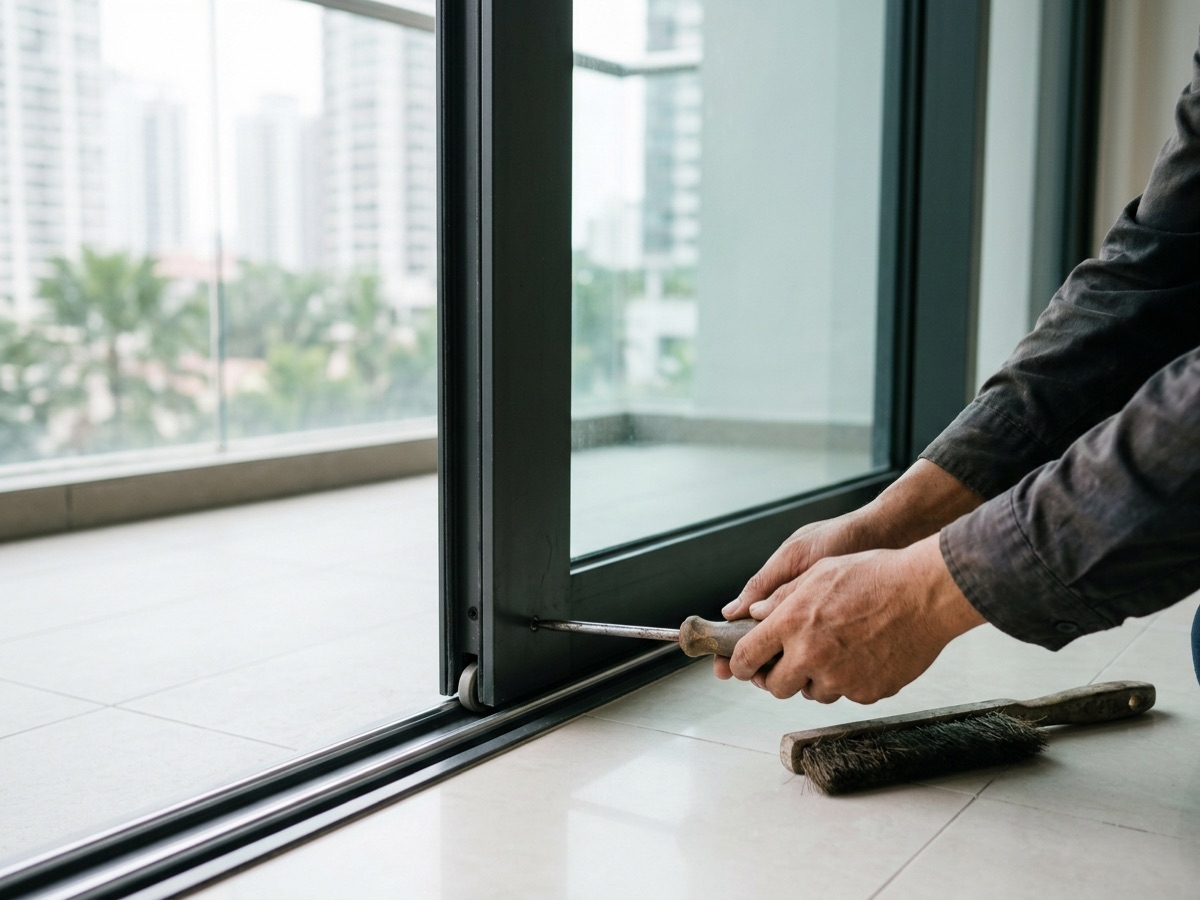
A sliding door runs on small rollers set in the bottom of the panel. Two things make it drag: grit packed into the track, and rollers that have worn.
The track is cleaned first, because that is sometimes the whole cure. Many rollers have an adjusting screw that raises or lowers one corner of the panel. That screw can also correct a door that scrapes at one end or will not meet its latch. A roller that is worn out is exchanged for one that matches the frame profile. That usually means lifting the panel out, so say in your message how tall and wide the door is.
Worn rollers are more likely where the door is original. A door in a 1990s tower such as Mont Kiara Pelangi may have been sliding for about thirty years. That is a guess from the completion dates, so send a photo of the bottom corner of your own door.
What the fault points to
| Fault | Usual reason | What is done |
|---|---|---|
| Sliding door heavy along its whole run | Dirt in the track, or rollers worn flat | Clean the track, then adjust or exchange the rollers |
| Sliding door scrapes at one end or misses its latch | One corner sitting low | The roller's adjusting screw |
| Window drops as it opens or will not pull tight | Worn friction stays | A matching pair of stays |
Window handle repair and worn stays
A casement window hangs on friction stays, the folding metal arms between the window and its frame. They wear. With tired stays a window drops as it opens, or will not close tight against its seal. Stays are exchanged for ones that match in length and type. A handle that turns without pulling the window in is exchanged like for like.
Work that has to be done from outside a high-rise window is not taken on. A stay or handle that can be reached from inside the room is a handyman job.
Door lock replacement by measurement
The lock on a room door, the lockset, is exchanged like for like, by measurement. Two numbers matter: how far the centre of the handle sits from the door edge, and how thick the door is. Photograph both against a tape measure before you buy. A set that does not match the old holes leaves them on show.
A hinged door that rubs its frame has usually dropped on its hinges or swollen. The hinges and the alignment are checked first. A loose handle or a weak latch on its own is listed with other odd jobs on the small repairs page.
Door closers
The closer is the arm and body at the head of the main door. Its adjusting valves set the closing speed, so a door that slams or stalls before the latch can often be put right by adjustment. A closer that leaks oil is replaced. The closer on an office or shop door is the same job, listed on the offices and shops page.
Timber doors at a house
A house has doors that face the weather: a timber front door, a back door to the yard, sometimes timber window frames. Timber that takes rain or afternoon sun swells and drops, so a door that shut cleanly in a dry spell binds in a wet one. The hinges are checked and reset first, and the edge is eased only if the door still rubs. An auto-gate motor is another trade's job.
The entrance door and anything seen from outside
In a strata building, the door into your unit is often fire-rated. The outside of your windows and balcony doors is part of the building's appearance. So ask the management before changing the entrance door, its lock or its closer, or anything visible from outside. If you rent, read your tenancy agreement too.
A digital lock you have bought
It can be fitted where the door suits it, which depends on the door's thickness and the cut-outs the old lock leaves behind. Send photos of both faces of the door, the door edge and the label on the lock's box. Because the lock normally goes on the entrance door, in a strata building the check with the management comes first.
What is not taken on
Lock-outs are a locksmith's call. Glass is not replaced, and new door or window frames are not supplied or installed. There is no metal grille fabrication and no welding.
How the job runs
Photograph the fault
The whole door or window, then the part that sticks: the bottom corner of a sliding panel, the stay, the door edge beside a tape measure.
Cause and part
The reply names the likely cause and says whether a part is needed and whether a match looks likely. The quote is in the same message.
Agree a slot
Monday to Saturday, 9 am to 6 pm, around what your management office asks of contractors, if you have one.
Adjust, exchange, test
The door or window is run through its full travel before the job is called done.
What moves the cost
Whether the cure is cleaning and adjustment or a new part. Whether a matching roller, stay or lockset can be found for an older frame. How many doors and windows are on the list. The quote comes after the photos.
A sticking door is seldom the only fault in a unit. See painting and touch-up for the marks a changed lock leaves, or the full list of services.
Questions about doors and windows
My block dates from the 1990s. Can rollers still be found for a sliding door that old?
Often, but not always. A roller has to match the frame profile, and an older profile is not always stocked. Send a close photo of the bottom corner of the panel, and of the roller itself if you can see it. The search is made from those before a visit is booked. If no match turns up, you are told so. A new door or frame is a different trade's job.
Can I change the lock on my main door without asking anyone?
Ask first. The entrance door of a strata unit is often a fire-rated door, and managements commonly want to know before it is drilled or its lock is changed. If you rent, your tenancy agreement is where to check whether the landlord's consent is needed and who holds the keys. With those two answers, send photos of the door edge and both faces, and the exchange can be looked at.
A bedroom window will not close tight. What is usually wrong?
Most often the friction stays. Once they wear, the window no longer sits square against its seal and a gap opens along one edge. Worn stays are exchanged for a matching pair. A handle that has stopped pulling the window in can cause the same fault. Send a photo of the open window that shows the metal arms, and say which floor you are on.