Boxes first, furniture second
A move into a Mont Kiara home often arrives as a stack of flat boxes. A tenant on a new posting orders a bed, a desk and a wardrobe ahead of the shipment. A landlord furnishes a bare unit between tenancies.
Furniture assembly turns those boxes into pieces that stand square and stay tight. It also covers the reverse: taking a piece apart for a move, and tightening one that has worked loose. The questions are the same in a 1990s block such as Mont Kiara Palma and in a tower such as 11 Mont Kiara. How do the boxes get upstairs, and is there room to build?
What to send
A photo of each box label, or of the order confirmation, is the quickest way to say it.
- What each piece is: bed, wardrobe, desk, table, bookcase, cabinet.
- How many of each.
- The maker and the model name, if you have them.
- Whether the boxes are already in the room where the furniture will stand.
- Your building and floor, or your road, and whether the boxes go up by lift or by stairs.
The model name tells how many panels, doors and drawers are involved. People often look for an IKEA furniture assembly service by that name. Flat-pack from there or from any other shop is built the same way. This is an independent handyman with no tie to any seller.
Delivery and the management office
Delivery is usually the seller's job, but the building has a say in it. Many management offices ask that large deliveries are booked ahead, go up in the service lift and keep to set hours. Those are house rules and they differ between towers, so ask yours before you fix a delivery date.
Ask about packaging on the same call. A wardrobe leaves a pile of cardboard, and many buildings have a rule for bulk waste.
A house has no lift to book. The boxes are carried up the stairs unopened and the piece is built in the room.
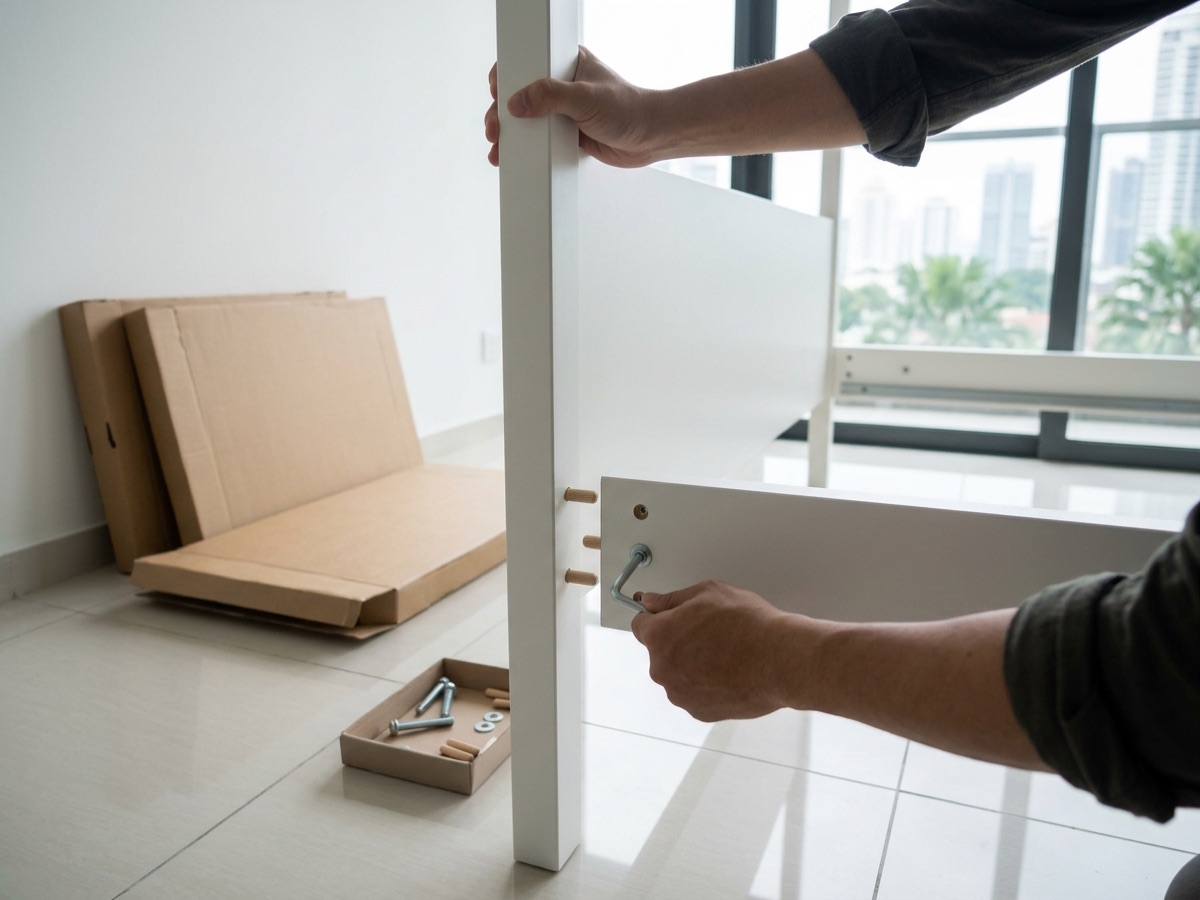
Bed and wardrobe assembly: why it is built in the room
An assembled wardrobe often will not pass a bedroom doorway, a corridor turn or a lift car. So a large piece is built where it will stay.
Wardrobes are commonly built lying down and then stood up. That only works if the ceiling is higher than the diagonal of the side panel. Where it is not, the piece is built upright. A photo of the room with the ceiling height answers this before the visit.
Before anything is joined, the parts and fittings are counted against the list in the instructions. A bag that is short of fittings, found at that point, is a message to the seller. Found halfway, it stops the job with half a wardrobe on the floor. The piece then goes together to the maker's instructions, step by step. Few floors are dead level, so the adjustable feet are set, or packers added, until the doors hang square.
Tall units are fixed to the wall
A tall wardrobe, bookcase or chest of drawers can tip forward when a child climbs it or several drawers are open at once. Makers usually supply a restraint for that reason, and it should be used.
The restraint is a wall fixing, so the wall decides how it is done. Concrete and brick take plugs and screws. A lightweight partition needs the right anchors or a fixing into its frame. The strata by-laws do not allow drilling or screws within 300 mm of concealed pipes and conduits, so the wall is checked with a detector before a mark is made. The page on TV mounting and curtain rails goes through wall types.
If you rent, a restraint means small holes in the landlord's wall. Your tenancy agreement says whether you need consent first.
Taking furniture apart when a tenancy ends
A posting ends and the furniture has to go somewhere: to the next unit, into a container or to a buyer. Most flat-pack comes apart the way it went together, in reverse. Fittings are bagged and labelled by piece so the next assembly is not guesswork.
Chipboard holds a screw less well each time the screw comes out. A bed or wardrobe that has already moved home two or three times may need its joints re-seated, and some pieces will not go back as tight as they were. You hear that when the piece is looked at, before it is taken apart.
The holes left where a restraint was fixed are a filling job. See painting and touch-up.
How the visit goes
Send the list
Pieces, quantities, model names, a photo of the room, your building and floor, or your road.
What the list tells
From the list it is clear what the job involves and whether one visit covers it. The quote follows.
Fix the day
Monday to Saturday, 9 am to 6 pm, at a time your management office allows, where there is one.
Build and check
Parts counted, pieces built in place, doors and drawers adjusted, tall units fixed back.
What moves the cost
The number of pieces. How involved each one is: doors, drawers, sliding gear and mirrors all add steps. Whether tall units need wall fixings, and into what kind of wall. Whether anything has to come apart first. Whether the boxes are in the room or still downstairs. A quote follows the list and the photos.
Furniture is often one line on a longer move-in list. A ceiling fan is easier to hang before a bed stands under it, so put everything in one message or use the contact page. Desks, cabinets and shelving for a workplace are on the offices and shops page.
Questions about furniture assembly
The instructions are missing. Can the piece still be assembled?
Often, yes. Many makers publish their assembly instructions online under the model name, so send that name or a photo of any label on the box or the back panel. With no name and no booklet, a plain bed frame or bookcase can usually be worked out from its parts. A wardrobe with sliding doors is harder, and you are told so before a visit is booked.
A fitting is missing or a panel arrived damaged. What happens then?
The parts are counted before anything is joined, so a shortage shows up at the beginning. A missing or damaged part is for the seller to replace, and the booklet usually gives the part number to quote. Whatever can be built without it is built. The rest waits for the part, and a second visit is agreed with you first, not assumed.
Can a wardrobe be moved to another room once it is built?
A small one, sometimes. A large one usually cannot go in one piece. It has to clear the doorway and turn in the corridor, and carrying it strains joints that were made to stand still. The safer way is to take it apart and rebuild it in the new room. Each rebuild wears the screw holes a little, so settle the position before the first assembly.